

Part of the The retractable pergola roof guide
Buying guide
Pergola shade.
By William Guthrie · Marketing, Eden Grove Outdoor Living
Published 26 August 2026
Published 26 August 2026
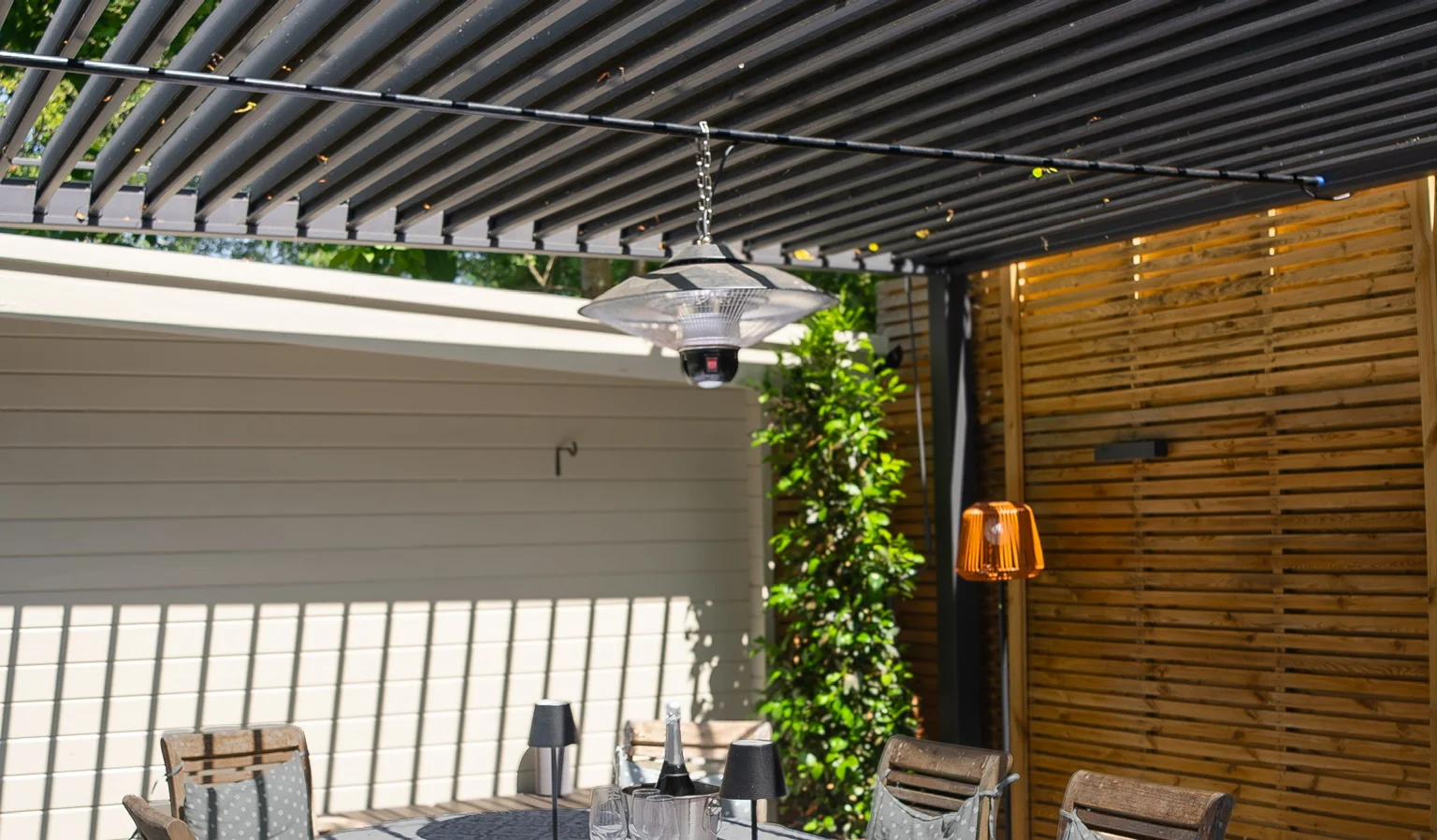
Most pergola shade works beautifully at one o'clock and abandons you by six. That is not a fault in the product. It is geometry: a roof only blocks sun coming from above it, and by early evening in a British summer the sun is not above anything. It is coming in sideways, under your expensive roof, directly into the eyes of whoever paid for it. The fix is not a better roof. It is knowing which half of the problem you actually have before you buy anything.
The 40 degree problem nobody mentions
Here is the number the shade industry has decided you do not need. A roof two and a half metres high with a three metre projection blocks sunlight arriving at more than about 40 degrees above the horizon. Below 40 degrees, the light goes under it and lands on your table. You can check the arithmetic yourself: it is the angle whose tangent is 2.5 divided by 3, which comes out at 39.8 degrees.
That would be a footnote if the British sun spent its time overhead. It does not. Using the standard formula for solar elevation, the sun at our latitude peaks at about 62 degrees on the longest day of the year, at roughly one in the afternoon. That is its best effort. For the rest of the day it is lower, and by evening it is down around 15 degrees, which is another way of saying it is pointed straight at your face.
So the roof does its job for a few hours either side of lunch, and then clocks off. The sun, unhelpfully, does not. In midsummer it sets in the northwest, which means it spends the entire evening working its way round to the exact position where a west-facing terrace gets it broadside.
This is why people buy a pergola, sit under it in July at seven in the evening, and quietly wonder what they have done. Nothing is broken. They bought a solution to the overhead half of a problem that has two halves.
Overhead shade, ranked by how honest it is
The overhead half is the easy half, and there are four ways to solve it.
Louvred aluminium blades rotate from open to closed. Open, they stripe the light; closed, they interlock into a solid surface and drain through gutters hidden in the frame and posts. They are the most useful answer because they are the only one you can change your mind about at two in the afternoon without getting a ladder out.
A folding fabric canopy concertinas back along a track, which is the subject of the next section because it is the one most people mean when they say retractable.
Glass or polycarbonate gives you a permanently dry space and almost no shade at all, which surprises people who did not think it through. Glass is a roof for rain, not a roof for sun. Clear glass will keep your dinner dry and cook you gently while it happens.
Planting is the oldest answer and still a good one. Wisteria over a frame is genuinely lovely, casts real dappled shade, and takes about five years to do it. It also drops everything it owns onto your table each autumn. The RHS climbers guide is a better source on this than we are, because we install aluminium and have obvious opinions.
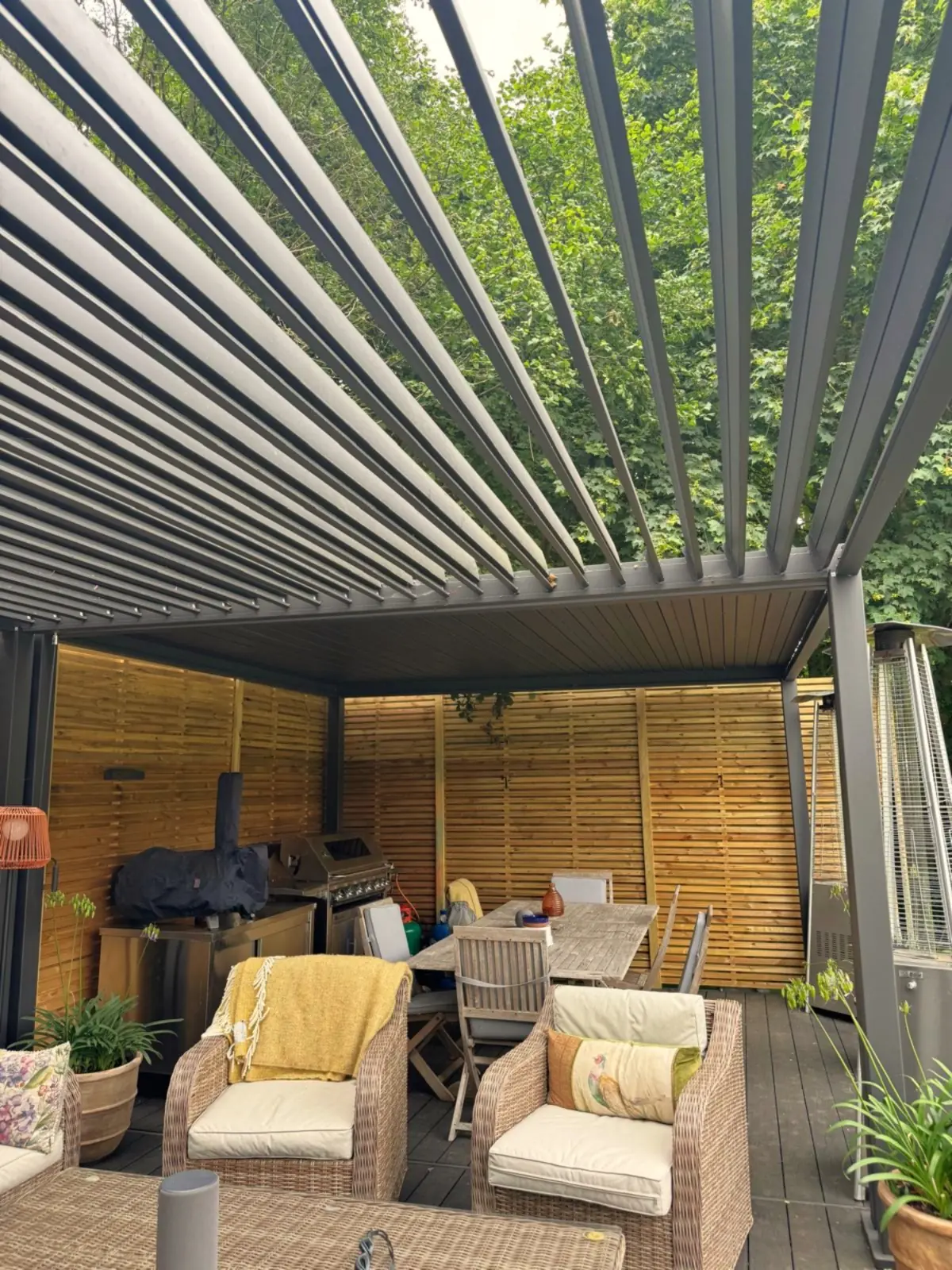
The ranking is not really about shade quality. All four will shade you at noon. It is about how much of the day they are useful for, and how many decisions they force you to make in advance and then live with.
Retractable fabric canopies, and what "retractable" is doing in that sentence
A retractable pergola canopy is a fabric roof that gathers back along runners, so you can have sky when you want sky. On the Deponti Verdeca the canvas runs on an anthracite aluminium frame, opens and closes on a SOMFY remote, and the rain gutter has an anti-draft system to stop wind getting in between the canvas and the rails. The fixings are stainless and concealed, which matters more than it sounds like it should, because exposed fixings are where an outdoor structure starts looking its age.
The canvas is described by the manufacturer as sun and water resistant. That is a precise phrase and it is worth reading precisely: water resistant is not the same word as waterproof, and anyone who tells you a fabric roof is the same as a sealed one is selling from the wrong end of the brochure. If your priority is being dry in November, a louvred roof closes into a continuous surface and a fabric one sheds. Both are useful. They are not the same promise.
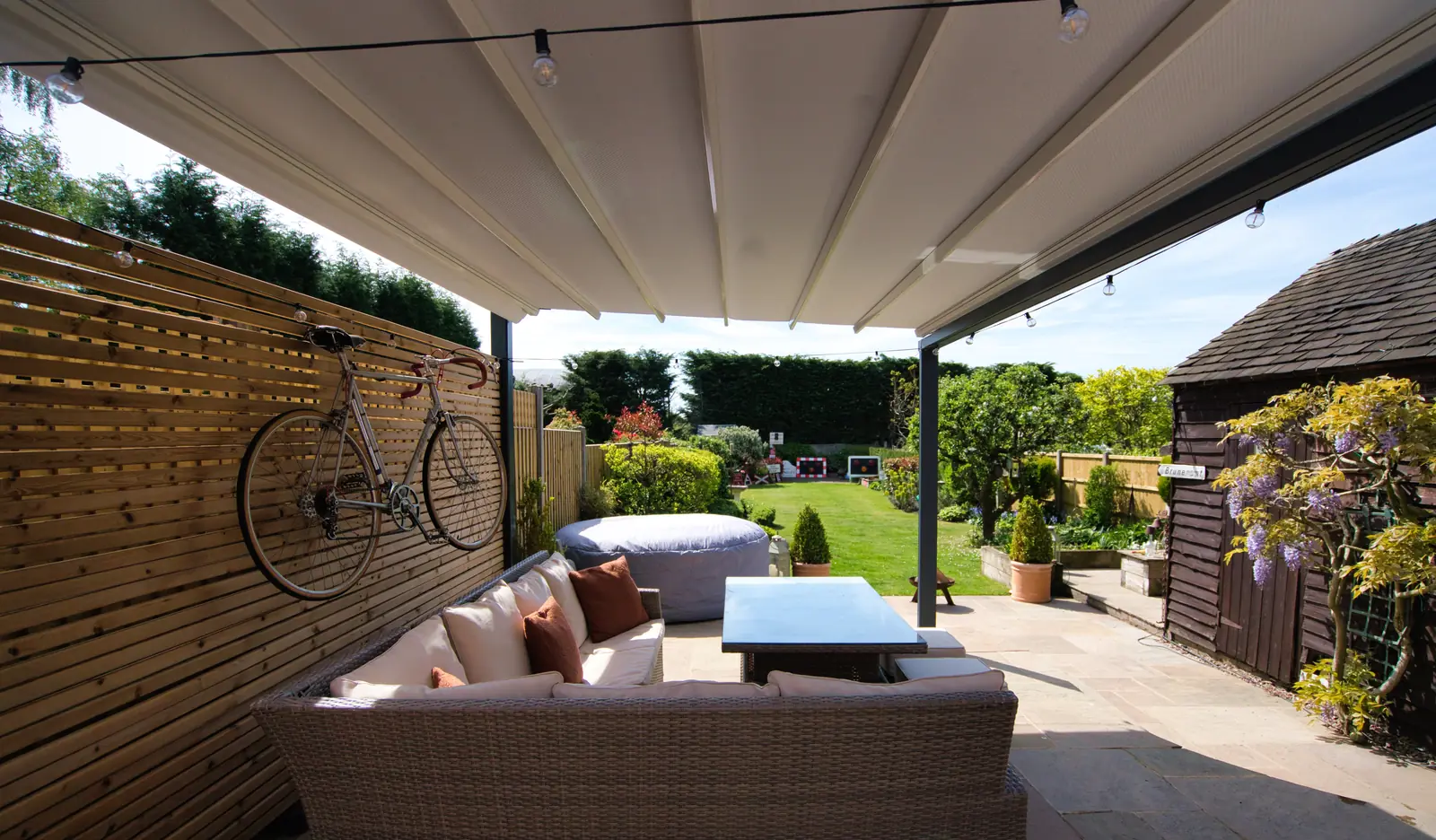
Where fabric genuinely wins is light. Closed louvres give you a dark ceiling. A pale canvas glows, and the space underneath stays bright even when the roof is shut, which is a real advantage on the grey days that make up a respectable share of the British calendar. If you want the full comparison of every roof type rather than just these two, the pergola roof guide does that job properly, and we sell the fabric version as our folding roof range.
The sun that gets underneath
Now the half that never makes it into the brochure, mostly because it is a great deal less photogenic than a sunset.
Below about 40 degrees, shade has to be vertical. That means a screen, a blind or a side panel: something that stands between you and the horizon rather than between you and the sky. Deponti call theirs screens and side walls, in polycarbonate or glass, plus side gables to close the wedge between the roof and the top of the side. They are covered on the veranda accessories page, which is a dull name for the parts that decide whether you actually use the thing.
A pergola blind does one job the roof cannot do at any price: it stops horizontal light. If your terrace faces anywhere between south and north going clockwise through west, the screen is not an accessory. It is the second half of the product, and treating it as an optional extra is how people end up with a beautiful structure they use until about half past five.
The order matters too. Fitting screens later is possible and routine. Fitting them later at a price you would have accepted up front is a different question, because you are paying twice for someone to come out, measure and fit.
Which way your garden faces changes the whole answer
This is the question to answer before any other, and it takes about ten seconds with the compass on your phone.
South-facing is the classic overhead problem. Sun high, most of the day, hitting the roof exactly as intended. Louvres or fabric will do almost all the work, and you may never need a screen at all.
West-facing is the one that catches people. Fine at lunch, unusable at seven, which is precisely when anybody wants to be out there. West-facing terraces need vertical screening more than they need roof, and the roof is what everybody buys first.
East-facing is the mirror image and much less of a problem, because the sun is low in the morning and most people are not eating breakfast outdoors in Kent with any regularity.
North-facing does not have a shade problem. It has a light problem, and the answer is a glass or polycarbonate roof that keeps the rain off without taking away what little sun reaches the space. Fitting a louvred roof to a north-facing terrace is buying a very good solution to a problem you do not have.
Sizes that actually cover the table
Shade is a footprint, not a frontage. The number that matters is projection, which is how far the structure comes out from the wall, because that is the dimension standing between the sun and the far side of your table.
A six-seat dining table with chairs pulled out wants roughly 3.5 metres of depth. Anything less and somebody is eating in the sun, and it will be the same person every time.
| System | Widths (mm) | Projections (mm) | Notes |
|---|---|---|---|
| Deponti Pinela louvre | 3124 / 3445 / 4088 / 5052 / 6016 / 6980 | 3000 / 3500 / 4000 / 4500 | Up to 7m on two posts, free standing on four. LED in the gutter as standard |
| Deponti Verdeca folding fabric | 4000 / 5000 / 6000 | 3000 / 3500 / 4000 | Anthracite RAL7024 frame, white sun and water resistant canvas |
| Eden Titan | 14 free standing sizes, 3 wall mounted | See range | Slim 80mm profile |
Every frame is BS EN1090 accredited, and exact sizes are confirmed at survey rather than chosen from a table, because gardens are not rectangles and neither are most walls.
Which brings up the strongest opinion on this page, and it is a narrow one on purpose. Six widths and four projections is the entire louvre catalogue. That is not a limitation we are apologising for. Serving a specific job properly beats serving every job averagely, and a company that offers you anything in any size is usually a company that has not made a decision about what it is good at.
What moves the price
We do not publish a price, because no price has been signed off for publication and inventing one to fill a paragraph would be a strange way to earn your trust. What we can do is tell you what the sliders are.
Projection does more than width. Coming further out from the wall means longer spans and more structure carrying them. Going wider is comparatively cheap.
Motorisation. A remote-controlled roof costs more than a manual one, and is one of the few upgrades nobody reports regretting, because the alternative is deciding at the start of the afternoon what the weather will do by four.
Screens and sides. The second half of the problem is also the second half of the invoice.
Groundworks. What is under your patio decides the foundations, and nobody knows what is under your patio, including you.
For a sense of scale rather than a quote: retractable fabric systems are publicly listed by UK retailers from a little under £4,800, with premium branded systems running past £6,500 and coupled units into five figures. Those are other people's published figures, not ours, and yours will depend on the survey.
Here is where we tell you not to call us. If the thing you want shaded is a table for four, in August, and you would like it dealt with by Saturday, buy a parasol. A good one costs about forty pounds, casts a genuinely useful circle of shade, and can be moved to follow the sun, which is a trick no fixed structure in this article can perform. Everything on this page is for people who want a space that works in October, not a patch of shade that works in a heatwave.
Which brings up the only sincere paragraph in this article. People kept telling Will they were too nervous to come to his run club, convinced everyone there would be younger and fitter than them. Then they turned up, and it was a completely different story every time. He has seen the same pattern at every good gym he has been into. The nerves are almost never about the thing itself; they are about not knowing what happens when you walk in.
Quotes work the same way. The site survey is free, it takes about an hour, and its main output is usually somebody telling you your garden faces west and you have been shopping for the wrong product. We cover Kent, Greater London and East Sussex, and installation is typically from one day once the structure is on site.
Frequently asked questions
How do you get shade under a pergola?
Shade under a pergola comes from two separate things: a roof for high sun and a vertical screen for low sun. A louvred or fabric roof handles sunlight arriving from above, roughly the middle of the day. Screens, blinds and side panels handle the low evening sun that passes underneath the roof entirely.
Does a pergola roof block the evening sun?
Usually not. A roof 2.5 metres high with a 3 metre projection stops sunlight above about 40 degrees of elevation. In a British summer the sun drops below that angle through the afternoon and sits at roughly 15 degrees by evening, so it passes under the roof. Vertical screening is what blocks it.
What is a retractable pergola canopy?
It is a pergola with a fabric roof that folds back along runners so the space can be open or covered. On the Deponti Verdeca the canvas is operated by a SOMFY remote, runs on an anthracite aluminium frame, and drains through a gutter fitted with an anti-draft system. The canvas is sun and water resistant rather than sealed.
Are pergola blinds worth it?
On a west-facing or south-west facing terrace they are usually the difference between using the space in the evening and not. A blind or screen is the only element that blocks horizontal light, which is what you get from mid-afternoon onwards. On a north-facing terrace they are rarely necessary.
Which direction should a pergola face for shade?
Aspect decides which product you need rather than whether you need one. South-facing terraces are an overhead problem and are solved by the roof. West-facing terraces need vertical screening as well, because the summer sun sets in the northwest. North-facing terraces need light rather than shade, so a glass or polycarbonate roof suits them better.
Do you need planning permission for a pergola with a roof?
Usually not, but height is the limit that catches people. Permitted development allows a maximum height of 2.5 metres where any part of the structure sits within two metres of a boundary, and 3 metres for a flat or mono-pitched roof further in. Listed buildings and conservation areas are assessed separately.
What size pergola do I need to shade a dining table?
Projection matters more than width. A six-seat table with the chairs pulled out needs roughly 3.5 metres of depth to keep everyone covered. Deponti Pinela projections run 3000mm to 4500mm and widths from 3124mm to 6980mm, so the table size sets the projection and the seating layout sets the width.
Ready to build something that lasts?
Speak to the team about your project, or read how we handle the practical side.
Free site surveys are subject to postcode.