

Part of the pergola design guide
Buying guide
BBQ shelters.
By William Guthrie · Marketing, Eden Grove Outdoor Living
Published 11 November 2026
Published 11 November 2026
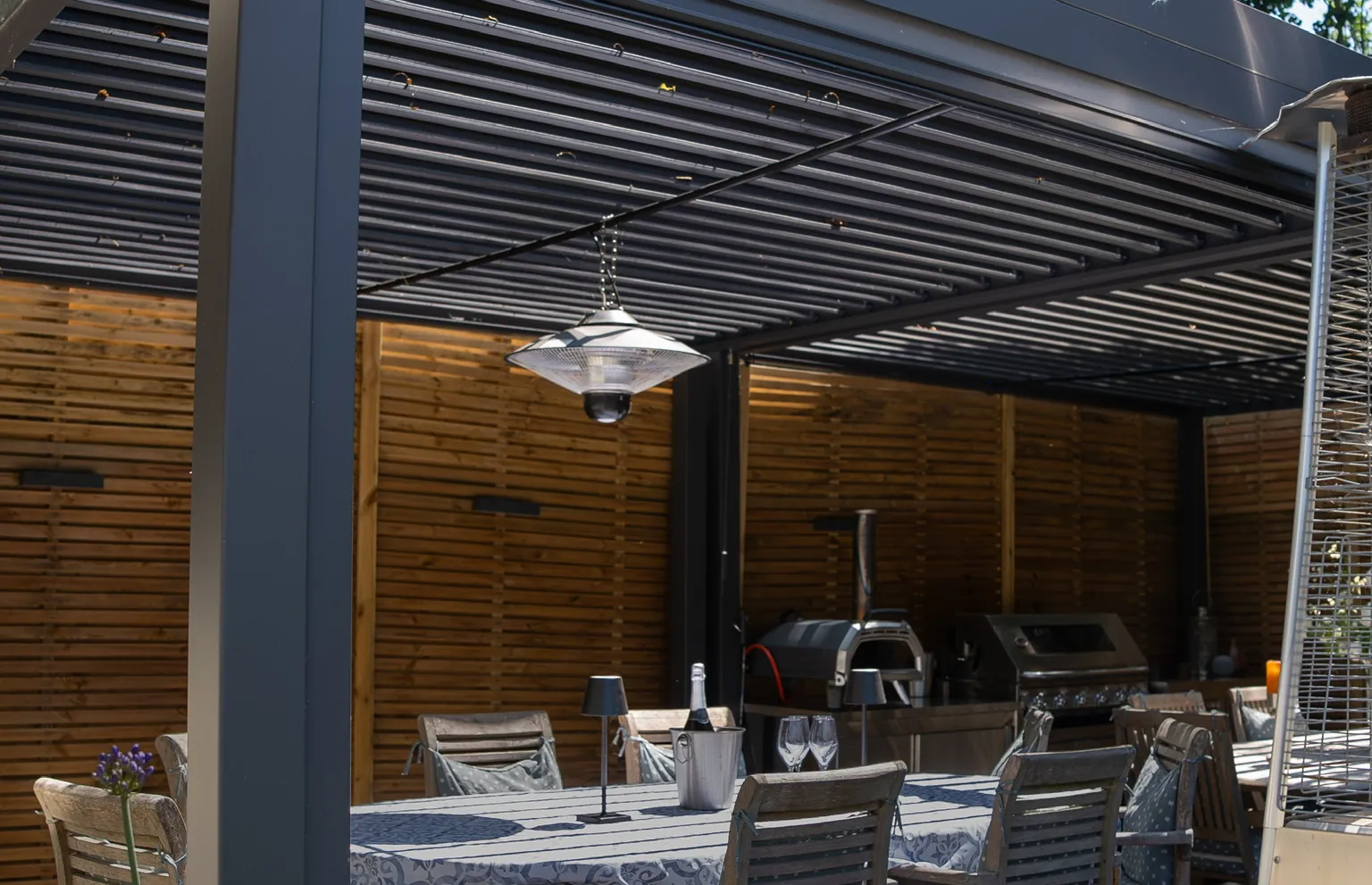
A BBQ shelter is a structure named after something the fire service tells you not to do. Kent Fire and Rescue Service put it in one sentence: "Never use a barbecue or patio heater under cover, in a tent or indoors due to the danger of carbon monoxide poisoning." Every company selling you a BBQ shelter is selling cover. Almost none of them mention that. The distinction that resolves it is mechanical rather than clever, and it is the only thing on this page worth remembering.
What the guidance actually says
Start with the source rather than the sales copy. Kent Fire and Rescue Service gives three instructions that matter here, and we are quoting them rather than paraphrasing because paraphrasing fire safety is how it gets softened.
Never use a barbecue or patio heater under cover, in a tent or indoors due to the danger of carbon monoxide poisoning. Stand the barbecue on level ground, well away from the house, sheds, fences and overhanging branches that could catch fire. Put the ashes onto bare garden soil, never into a bin.
The gov.uk outdoor fire safety guidance says the same thing in different words. Neither document defines "under cover", which is inconvenient for an industry that sells covers for a living, and which is why the next section exists.
We are an aluminium structures company. We are not a fire authority, we hold no fire or heat rating for anything we sell, and you should take the safety call from the people whose job that is rather than from a company hoping to quote you.
Cover, and the thing that is not cover
Here is the whole argument. A fixed roof is cover. It is cover in August and it is cover in November and there is nothing you can do about it while the barbecue is lit.
A louvred roof opens. Blades rotate from closed to open, and open is a roof with sky through it. That is not a marketing distinction, it is a different physical arrangement, and it is the only reason an engineered structure has anything to say on this subject that a gazebo does not.
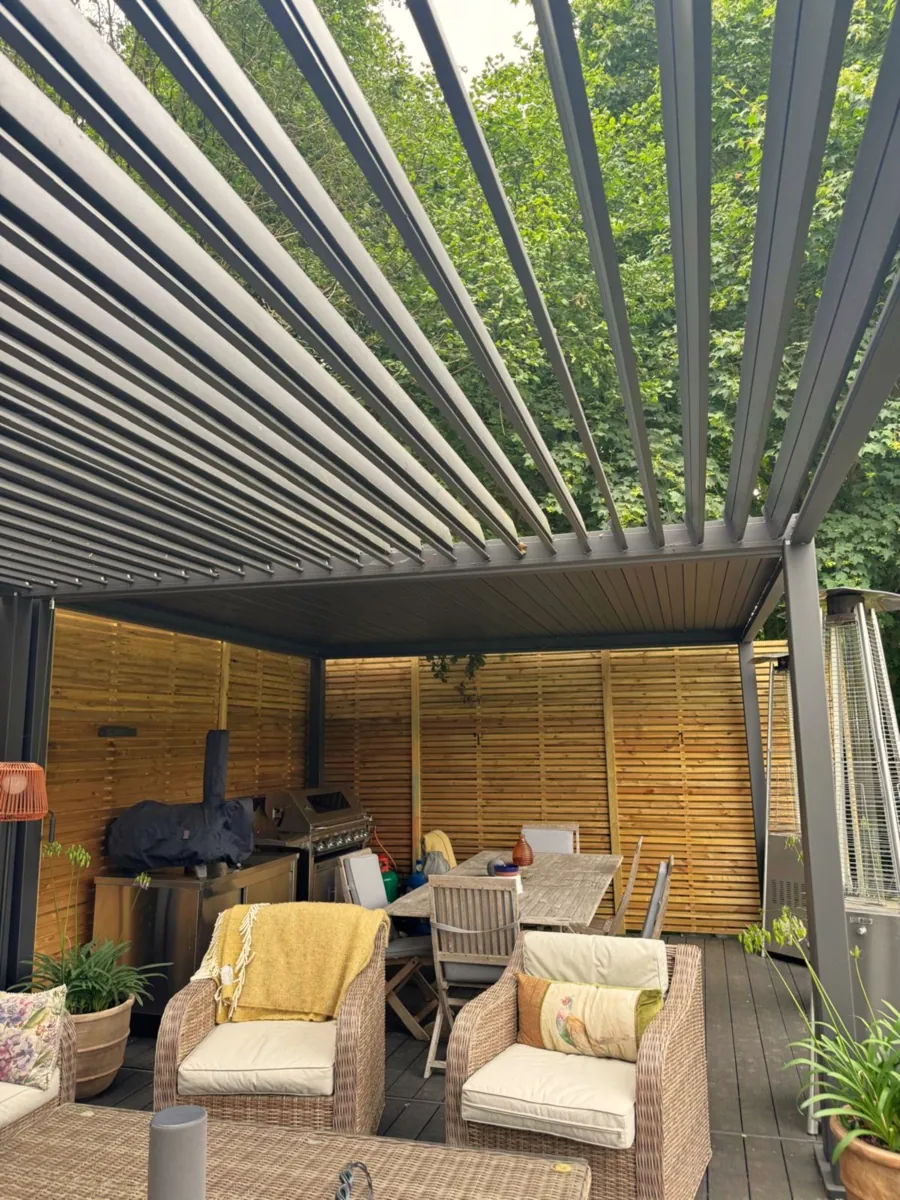
So the honest version of the sales pitch is narrower than the one you will be given elsewhere. A louvred structure lets you cook with the roof open and eat with it closed. It does not make a barbecue safe under a closed roof, and anybody telling you it does is answering a question the fire service has already answered differently.
Fabric is the other end of this. A canopy over a grill is the arrangement the guidance is most obviously describing, and it is also the one most likely to be flammable. Glass and solid roofs do not open at all, which makes them excellent rooms and poor barbecue shelters.
Carbon monoxide is a combustion problem, which changes what applies to what
Worth separating, because the fire service sentence names barbecues and patio heaters together and most people read that as one rule about two objects.
Carbon monoxide comes from burning. Charcoal burns. Gas burns. Both produce it, both keep producing it while the coals cool, and that is why the guidance is as blunt as it is about enclosed spaces.
An electric infrared heater does not burn anything. There is no combustion and therefore no carbon monoxide, which is why an overhead electric heater is a normal thing to mount under a pergola and a gas patio heater is not the same object at all. Ours run at 1.8kW. That is the only figure we publish about them, because it is the only one we can source.
The practical read: the roof position matters for the grill, and the heater is a separate question with a different answer.
Roof types, ranked for this specific job
Ranked for barbecuing, which is a narrower test than ranking them for anything else.
| Roof | Opens? | Notes for a grill |
|---|---|---|
| Louvred aluminium | Yes, blades rotate | Cook open, eat closed. Rain-tight when shut, and the gutters drain through the posts |
| Folding fabric | Yes, concertinas back | Opens fully, but fabric over a heat source is the arrangement the guidance warns about most |
| Glass or polycarbonate | No | A dry room and a permanent roof. Good building, wrong job |
| Solid insulated | No | The most weatherproof and the least suitable here |
| Open slatted timber | Permanently open | Never cover, and never shelter either. Honest about what it is |
Every frame we fit is BS EN1090 accredited, which is the structural standard for aluminium fabrication. It is worth saying plainly that this has nothing to do with fire or heat, because accreditation logos have a habit of drifting across a page and picking up meanings they were never given.
Where the grill goes, which is a layout question
The fire service line about standing it well away from the house, sheds, fences and overhanging branches is the constraint most gardens fail first, and it is a layout problem rather than a product one.
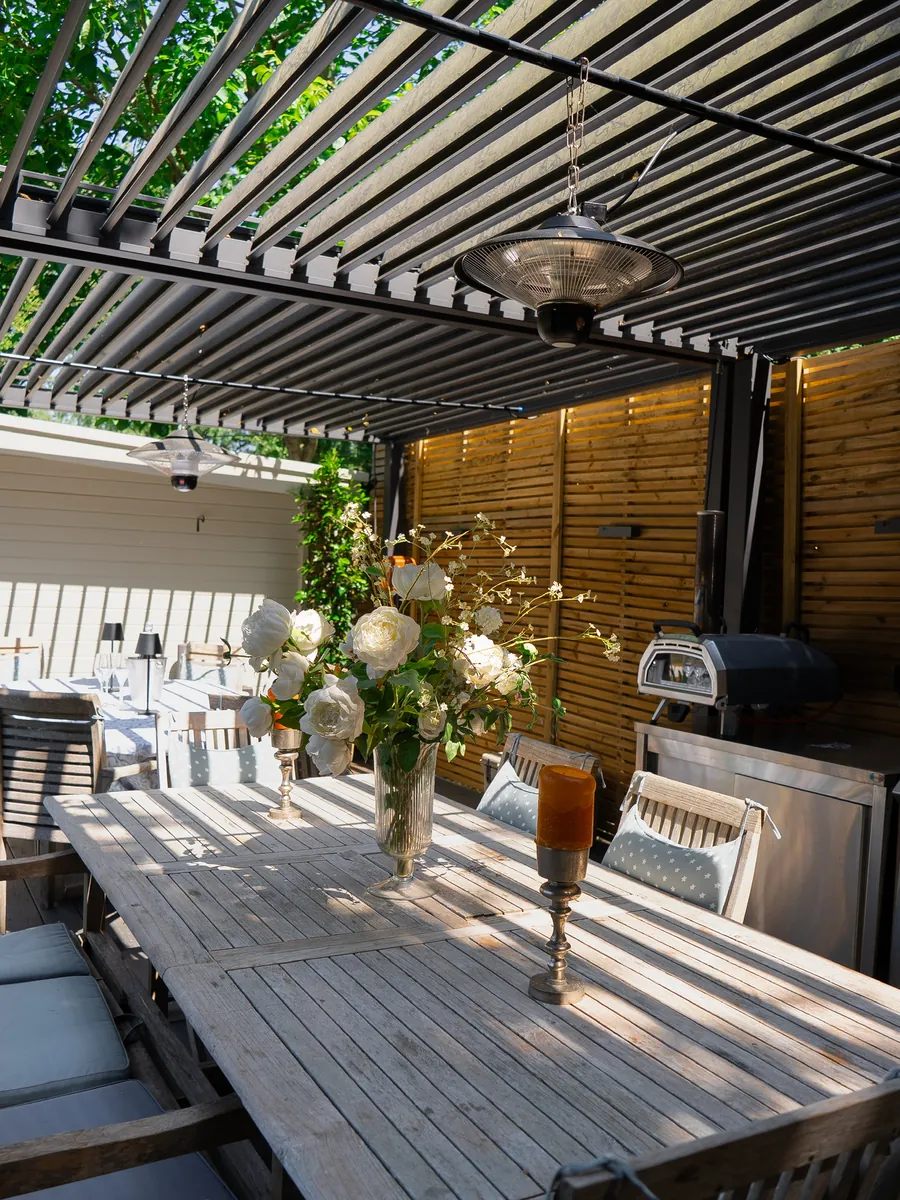
Put the cooking end at the outside edge of the structure, not in the middle. Run the sequence as prep, cook, serve, so the grill sits at the far end and smoke drifts away from the table rather than across it. Keep it off the boundary, which usually means keeping it off the fence your neighbour thinks of as theirs.
Our garden and patio ideas guide covers the layout side properly, and the pergola roof guide compares every roof type rather than just the five above.
What it costs, and when to spend nothing
An engineered aluminium structure over an outdoor kitchen is a five-figure decision at the top end and a four-figure one at the bottom. Our Titan range runs from £1,299 to £5,399 including VAT across fourteen free-standing sizes, and an overhead infrared heater adds £299. Bigger spans cost more because the structure carrying them grows, and the post count changes at 6 metres wide, which is worth knowing before you fall in love with a dimension.
Now the part that costs us money to write. If the actual problem is that your barbecue is rusting because it lives outside, buy a fitted cover. About thirty pounds, does that one job better than any structure on this page, and takes four seconds. A structure is for the times you want to stand outside in October, not for keeping a lid dry.
If you do want the structure, we survey, supply and install across Kent, Greater London and East Sussex, and installation is typically from one day once it is on site. The louvered roof installation page covers how that works.
Frequently asked questions
Can you use a barbecue under a pergola?
Kent Fire and Rescue Service advises never to use a barbecue or patio heater under cover, in a tent or indoors, because of the danger of carbon monoxide poisoning. A pergola with a fixed roof is cover. A louvred roof opens, which changes the arrangement, but the guidance does not define the term under cover, and the safety judgement belongs with the fire service rather than with a manufacturer.
Is it safe to barbecue under a louvred roof?
The relevant difference is that the blades open, so the space above the grill can be sky rather than roof. That is a physical change rather than a claim about safety. No aluminium pergola carries a fire or heat rating, ours included, so the fire service guidance is the thing to follow.
Do you need ventilation for a BBQ shelter?
Carbon monoxide is produced by burning charcoal or gas, and it continues while the coals cool. Fire service guidance is to avoid enclosed and covered spaces entirely rather than to ventilate them, which is a stronger instruction than adding airflow.
What is the best roof for a BBQ shelter?
For cooking specifically, a roof that opens. A louvred aluminium roof rotates its blades open and closes rain-tight afterwards. Glass, polycarbonate and solid roofs do not open at all, and a fabric canopy sits directly over the heat source.
Can you put a patio heater under a pergola?
It depends on the type, and the distinction is combustion. A gas patio heater burns fuel and produces carbon monoxide, which is why fire service guidance names it alongside barbecues. An electric infrared heater burns nothing and produces no carbon monoxide, which is why overhead infrared is the type normally integrated into a pergola frame.
Do you need planning permission for a BBQ shelter?
Usually not. Permitted development allows a maximum height of 2.5 metres where any part of the structure sits within two metres of a boundary, and 3 metres for a flat or mono-pitched roof further in. Listed buildings and conservation areas are assessed separately.
What do you do with the ashes?
Kent Fire and Rescue Service advises putting ashes onto bare garden soil and never into a bin. Ashes continue to give off carbon monoxide while they cool, which is also why they should not be brought inside.
Ready to build something that lasts?
Speak to the team about your project, or read how we handle the practical side.
Free site surveys are subject to postcode.